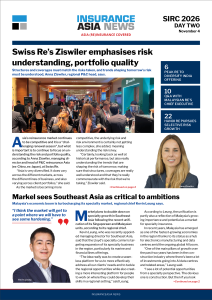
SIRC 2026: Diary day two – Imposter syndrome
November 3 2026 by Marcus Alcock
I guess we’ve all been in situations where we feel we’re not properly qualified to be there and there’s surely been some mistake, but – as a journalist with 30 years of experience writing about the (re)insurance market – I never thought that this feeling would happen to me at an industry conference. Yet imposter syndrome crept upon me at the end of the address by Chee Hong Tat, Minister for National Development and deputy chairman of the Monetary Authority of Singapore.
There I was, perched on end of a front row seat which I had nabbed in order to take some decent photographs of the speakers and to make sure I could have a clear audible record of the addresses. Suddenly everyone in my row stood up and the minister came down and passed down the line, shaking everyone’s hand – clearly this was some sort of official delegation. When he came to me and offered his hand, I could hardly remain seated, so I stood up and shook his too. A proper imposter!
Next on stage was Thierry Léger, CEO of Scor. Often at these conferences these sorts of keynotes can be filled with platitudes, but here Léger offered words that left me with a really uneasy feeling as I wondered what the ultimate outcome of all of this will be.
One of his main topics, you won’t be surprised to learn, what that of AI, and the implications this will have for the wider (re)insurance market. Here Léger was clear that this technology will be transformative for the market, but will not be without its problems, most notably lingering issues over reliability and the need for proper oversight.
Yet his most telling revelation, as we wrote in yesterday’s edition, was that Scor has this year been piloting a fully autonomous AI underwriting system, with, in theory, no need for human involvement in the actual underwriting process. Yes, you heard that right: this system is able not only to analyse the risk, but also to assess the commercial rating environment and then to quote and bind. No flesh and bone involved.
AI oversight
Léger was fairly clear that human oversight and proper governance protocols will still be needed for such AI underwriting tools, but the brutal reality here is obvious: in future, there will be need for considerably fewer underwriters than there are at present if AI can automate the whole process. Sure, experienced market players will still be needed to check that these AI agents are going AWOL. But how many of these will really be needed? And what happens to the rest? I fear that we could be at the start of a wave of serious culling in the market. And not just for underwriters, right? AI is both amazing and terrifying in equal measure. Gulp.
-
BlackRock | Rethink the rules: how TAA and ETFs are reshaping portfolio construction
BlackRock's Daniel Caderas and MSCI's Raman Aylur Subramanian explain why tactical asset allocation (TAA) and exchange-traded funds (ETF) have become essential as global markets fragment and static allocations lose their reliability.
-
BlackRock | Infrastructure comes of age for insurers
Are insurers capturing full value from the asset class? BlackRock shares its perspective.
-
Beazley | Navigating geopolitical risks at sea
Maritime shipping faces growing geopolitical threats — missiles, drones, GPS interference, and cyber sabotage — requiring better intelligence, crew welfare, and resilience measures.
-
Zurich | Why resilience will define the winners of Asia’s clean energy transition
Planning for future conditions from the outset can improve operational reliability, reduce potential disruption and protect long-term asset value.