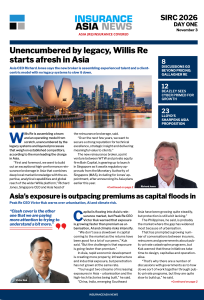
SIRC 2026: Asia’s exposure is outpacing premiums as capital floods in, Peak Re CEO warns
November 3 2026 by Mithun Varkey
Capital is flowing into Asia’s reinsurance market, but Peak Re CEO Victor Kuk warned that exposure is growing faster than premium as urbanisation, AI and climate risks intensify.
“We don’t see a slowdown in capital coming to the market as the returns have been good for a lot of our peers,” Kuk said. “But the challenge is that exposure is going faster than premium.”
In Asia, rapid economic development is creating more property, infrastructure and industrial exposure, but penetration has not grown at the same rate.
“You’ve got two streams of increasing exposures in Asia – urbanisation and the high-tech factories being built,” he said.
“China, India, emerging Southeast Asia have been growing quite steadily, but protection is still a bit lacking.”
The Philippines, he said, is probably the market where the gap has widened most because of urbanisation.
That has prompted a growing number of conversations between insurers, reinsurers and governments about public-private catastrophe programs, but Kuk warned that these initiatives take time to design, capitalise and operationalise.
“That’s why there are a number of discussions with governments as to how do we sort of work together through public-private programs, but they are quite slow to build up,” he said.
High-tech investments
Beyond traditional catastrophe exposure, Kuk identified the rapid build-out of data centres, AI infrastructure and semiconductor facilities as one of the most consequential changes in the risk landscape.
“If you look at the risk exposures, especially from data centres, AI and semiconductors, it’s becoming more complex,” Kuk said. “They are all interconnected now.”
For reinsurers, the central question is aggregation.
“If you look at AI data centre, when a loss happens, how many treaties respond to the loss is something that we need to understand a lot better for us to underwrite,” he said. “Our concern for AI data centres is aggregations of exposures. Do we really have a good understanding of that?”
Kuk also highlighted “clash cover”, where a single event produces losses across more than one line of business or policy.
“Clash cover is the other one that we are paying more attention to trying to understand a bit more,” he said.
“I think when the wordings are not clear, sometimes they can end up in either property or maybe casualty liability. There could be hidden exposures within data centres.”
His advice to clients is to focus first on prevention.
“Only after understanding both the exposure and the mitigation measures can reinsurers develop appropriate program structures,” he added.
Soft market, stronger demand
While many cedents reduced reinsurance purchases during the hard market to stay within budgets, with pricing now more favourable, Kuk expects buyers to return to the market.
“Now, clients are starting to look at buying more, because price is softening, to protect themselves, whether it’s aggregates or increased vertical limits,” he said.
He expects structural discussions to become more prominent after several renewal cycles in which they were relatively limited.
Cedents are beginning to ask about aggregate covers, changes to attachment points and sub-layers.
“If you look at the last three or four renewals, the discussions over the program structure have been quite limited,” Kuk said.
“Attachment points is one part that I think are starting to see cedents request a change, or buying some sub-main layer type programs, also something that is coming back to the market. It’s not coming back as significantly as before the hardening cycle. It’s more selective.”
“We are aware of the price softening and we need to make sure the adequacy is still in place for us to continue the engagement.” Victor Kuk, Peak Re
Commission levels are also moving again.
“During the hard market, commissions fell,” but Kuk said recent quotations show clients asking for higher commissions as the market softens.
Reinsurers now have a better understanding of what cedents’ exposures are since the hard cycle, Kuk said.
“But the flip side is it’s an open market, depending on how hungry others are the market could change quickly,” Kuk said.
“Despite the softening, underwriters were still very cautious in terms of how capacity was deployed last year.”
There, Kuk, added, will be likely a lot of overplacement.
Growth with discipline
Peak Re plans to continue expanding in Asia while building its presence in the United States and Europe.
In the US, the company currently focuses on casualty and plans to expand into property and specialty through 2027, while in Asia, it is targeting incremental growth in larger markets including China, India, Japan and Australia, and remaining alert to softening prices.
“We are aware of the price softening and we need to make sure the adequacy is still in place for us to continue the engagement,” Kuk said.
“Some of our growth will be coming from the new initiatives.”
Peak Re grew its GWP by 25% in 2025 and expects double-digit growth in 2026 and expect that to continue, although the growth rate will be adjusted based on the market conditions.
The company is also exploring MGA distribution.
“MGAs is one area we want to see how we can grow through, but we need to make sure we select the right distributors,” he said.
On retrocession, Peak Re is finalising its program and considering sidecars and catastrophe bonds, although neither is likely to be issued for the January 1 renewal.
“We do want to have a look how we use sidecar as a way for us to manage our retro programs,” Kuk said. “Cat bonds are also part of our retro strategy.”
-
BlackRock | Rethink the rules: how TAA and ETFs are reshaping portfolio construction
BlackRock's Daniel Caderas and MSCI's Raman Aylur Subramanian explain why tactical asset allocation (TAA) and exchange-traded funds (ETF) have become essential as global markets fragment and static allocations lose their reliability.
-
BlackRock | Infrastructure comes of age for insurers
Are insurers capturing full value from the asset class? BlackRock shares its perspective.
-
Beazley | Navigating geopolitical risks at sea
Maritime shipping faces growing geopolitical threats — missiles, drones, GPS interference, and cyber sabotage — requiring better intelligence, crew welfare, and resilience measures.
-
Zurich | Why resilience will define the winners of Asia’s clean energy transition
Planning for future conditions from the outset can improve operational reliability, reduce potential disruption and protect long-term asset value.