



Infrastructure has evolved from a specialist alternatives allocation into one of the fastest-growing segments¹ of institutional portfolios. Once the preserve of pension funds and sovereign wealth funds, it is increasingly becoming a core strategic allocation for insurers.
This article explores three themes: why infrastructure has reached institutional scale, why infrastructure debt and infrastructure equity play different roles in insurer portfolios, and how insurers can determine whether infrastructure warrants dedicated treatment within strategic asset allocation.
Growing scope
The infrastructure opportunity has expanded significantly across the capital stack and beyond traditional core assets such as toll roads, airports and utilities. Today, it also encompasses renewable power and energy-transition assets, as well as digital infrastructure spanning fibre networks, telecommunications towers and data centres. These areas all require significant investment.
Meanwhile, governments increasingly require private capital to bridge funding gaps.
For institutional investors, this is creating a growing opportunity set across both infrastructure debt and infrastructure equity.
Market depth
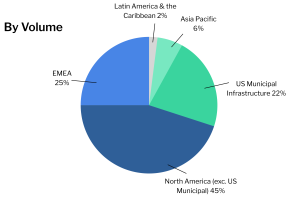
Infrastructure is no longer a niche market. Moody’s rated infrastructure debt and project finance universe now contains more than 2,600 securities representing around US$3.6 trillion of issuance globally1. While this captures rated infrastructure and project finance securities rather than the entire private infrastructure market, it is a useful indicator of the asset class’s institutional scale and breadth. North America (excluding US municipal infrastructure) accounts for around 45% of outstanding debt volume, with Europe contributing around 25%, Asia Pacific around 6%, US municipal infrastructure around 22%, and Latin America & Caribbean around 2% (see Moody’s Ratings exhibit below)² .
The infrastructure landscape has also become increasingly diversified across sectors. Utilities, transportation, digital infrastructure and energy-transition assets provide exposure to different economic drivers and structural growth themes than many corporate-credit sectors, creating a broader investable market than many investors assume. Utilities alone account for a substantial proportion, while airports, roads, ports, energy projects and communications infrastructure continue to expand.
This diversification gives insurers access to multiple implementation objectives, ranging from long-duration income generation through infrastructure debt to inflation-linked growth through infrastructure equity.
Distinct drivers
Infrastructure is often grouped alongside private equity, private credit and real estate. Yet infrastructure debt and infrastructure equity are increasingly being assessed as distinct allocations, reflecting return drivers, risk characteristics and liability-matching properties that differ materially from traditional private market exposures.
Infrastructure equity is typically backed by essential operating assets that generate contracted, regulated or highly predictable cashflows. Revenue is often linked to asset utilisation, availability payments or regulated frameworks rather than corporate earnings growth alone, creating a different return profile from traditional private equity.
Similarly, infrastructure debt differs from many corporate private-credit strategies (for example traditional direct lending) because cashflows are typically supported by long-term projects, essential-service demand and tangible underlying assets. As a result, investors may benefit from stronger downside protection and lower historic loss rates as well as inherent diversification due to novel sources of income intrinsic to infrastructure projects while still capturing an illiquidity premium.
For insurers, infrastructure debt and infrastructure equity can provide combinations of income generation, diversification, inflation linkage and liability matching that may not be fully captured by existing private equity, private credit or real estate allocations. The question is therefore not simply whether infrastructure belongs within alternatives, but whether infrastructure debt and infrastructure equity each warrant separate treatment because of their potential to solve different portfolio problems.
Different roles
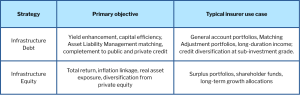
Importantly, insurers may wish to compare infrastructure debt not only against other forms of private credit, but also against public investment-grade credit where the private market premia may improve portfolio efficiency. Likewise, infrastructure equity should be assessed relative to private equity and real assets, where its combination of inflation linkage and cash-flow visibility may offer attractive diversification characteristics.
Debt appeal
The case for infrastructure debt extends beyond yield, encompassing portfolio resilience and, in some jurisdictions, capital-efficiency advantages.
Investing in infrastructure debt:
- Gives investors access to high-quality real assets without the full ownership and operational due diligence requirements associated with equity investments.
- Provides immediate income enhancement, offering predictable income independent of portfolio exits.
- Delivers diversification benefits while offering steady cash flows from an earlier stage, a lower risk profile and access to a broader mix of assets.
Delving deeper, investment-grade infrastructure debt has exhibited slightly lower default experience than investment-grade corporates, with somewhat stronger recovery rates and characteristics that may support long-duration income and liability matching. Sub-investment-grade infrastructure debt, while typically representing a smaller allocation for insurers, has demonstrated notably better default experience than comparable high yield corporates, alongside an attractive combination of higher income potential and shorter duration.³
Equity case
Meanwhile, infrastructure equity can offer insurers higher total return potential, inflation-linked growth and exposure to long-term structural themes. Relative to infrastructure debt, it typically carries higher volatility and solvency capital requirements, making it particularly relevant for surplus portfolios and long-term growth allocations.
Allocation choice
As infrastructure allocations continue to grow, insurers are increasingly evaluating how the asset class should be reflected within their strategic asset allocation framework. This becomes an explicit architecture decision: create a dedicated infrastructure allocation with specialist governance, or evaluate infrastructure debt and equity against existing public credit, private credit, real assets and private equity allocations.
Many of the world’s largest infrastructure investors have moved towards dedicated allocations to both infrastructure debt and infrastructure equity, recognising that each serves a distinct role within the portfolio.
Creating dedicated infrastructure allocation, or cross-asset class allocations that more wholly consider risk and return portfolio characteristics, can provide greater transparency over portfolio exposures, establish clearer governance and strategic objectives, and enable specialist manager oversight tailored to the unique characteristics of infrastructure investing. It also allows insurers to make explicit decisions regarding their desired exposure to infrastructure rather than relying on allocations that are embedded across broader asset categories.
For insurers earlier in their infrastructure journey, a dedicated allocation may not be necessary initially. Instead, infrastructure can be assessed relative to existing investment opportunities within public investment-grade credit, private credit, real assets and private equity portfolios. The key question is whether infrastructure offers superior risk-adjusted outcomes, diversification benefits, liability-matching characteristics or capital efficiency compared with incumbent allocations.
Specialist skills
Regardless of the approach adopted, infrastructure is increasingly becoming a deliberate portfolio construction decision rather than a by-product of broader private market investing. As the asset class continues to expand and mature, insurers will need to determine the role they want infrastructure to play within their long-term portfolio construction framework.
Many of the world’s largest infrastructure investors have established specialist infrastructure teams, reflecting the unique sourcing, underwriting and portfolio-management requirements of the asset class. The ability to evaluate regulatory frameworks, concession agreements, construction risk, energy markets and asset-operating characteristics often differs materially from traditional private equity, real estate and corporate credit investing.
For insurers that do not yet have sufficient scale to develop dedicated teams internally, partnerships with experienced infrastructure managers can provide access to sourcing networks, specialist expertise and implementation support.
Final question
Ultimately, the debate is shifting from whether insurers should invest in infrastructure to how infrastructure should be incorporated within portfolio construction. Whether implemented through dedicated infrastructure allocations or evaluated within existing asset buckets, insurers will increasingly need explicit governance, benchmarks and manager-selection frameworks that reflect the distinct roles of infrastructure debt and infrastructure equity.
[1] Preqin, Institutional Allocation Study 2025, April 2025. Preqin, Global Report: Infrastructure 2025, December 2024
[2] Moody’s Ratings, Infrastructure Default and Recovery Rates, 1983-2024, 3 September 2025.
[3] Moody’s Ratings, Infrastructure Default and Recovery Rates, 1983-2024, 3 September 2025
-
Beazley | Navigating geopolitical risks at sea
Maritime shipping faces growing geopolitical threats—missiles, drones, GPS interference, and cyber sabotage—requiring better intelligence, crew welfare, and resilience measures.
-
Zurich | Why resilience will define the winners of Asia’s clean energy transition
Planning for future conditions from the outset can improve operational reliability, reduce potential disruption and protect long-term asset value.
-
Sedgwick | Captives in Asia: From Niche Solution to Strategic Risk Platform
Captive insurance has evolved from niche tool to strategic risk infrastructure in Asia, with connected claims data seen as key to unlocking its full value.
-
BlackRock | Rethink the rules: how TAA and ETFs are reshaping portfolio construction
BlackRock's Daniel Caderas and MSCI's Raman Aylur Subramanian explain why tactical asset allocation (TAA) and exchange-traded funds (ETF) have become essential as global markets fragment and static allocations lose their reliability.