
Full Capacity: Capital, competition and the cycle
August 15 2026 by Mithun Varkey
Welcome to Full Capacity, a weekly briefing on all the most important developments of the past week with a personal take on the news from our editor-in-chief, Mithun Varkey, delivered to your inbox every Saturday.
Steady hand. The Hong Kong government has reappointed Clement Cheung as CEO of the insurance regulator for another three-year term till August 14, 2029. Cheung has led the Hong Kong Insurance Authority since 2018.
Choppy waters. P&I clubs have started cancelling war risk cover for vessels trading to, from, through, or within the territorial waters of the Indian Ocean, Gulf of Aden and Red Sea following receipt of cancellation notices from their respective reinsurers.
Nat cat update. Insurers across five provincial-level regions have received nearly 100,000 claims reports, with an estimated loss of CNY1.2 billion (US$178 million), after Typhoon Dolphin made landfall in China this week
M&A spotlight. Axa General Insurance Korea is reportedly the target of a strategic evaluation by Kyobo Life, which is considering its acquisition as a move to re-enter the non-life insurance sector and broaden its business scope beyond life insurance.
Gaining momentum. The Tasmanian government has entered an interim partnership with the Royal Automobile Club of Tasmania “to accelerate the work needed to deliver” the proposed state-backed insurer, TasInsure.
Litigation overhang. IAG’s exposure to litigation relating to the collapse of Greensill Capital in 2021 continues to cast a shadow over the Australian insurer following its FY26 annual results, with CEO Nick Hawkins hinting that it could settle the remaining US$2 billion claimsbrought by Credit Suisse and White Oak ahead of the trial next month.
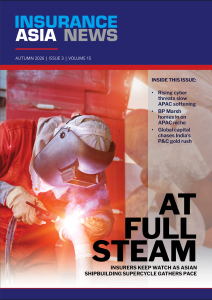
High tide. A shipbuilding supercycle, overwhelmingly centred in Asia, is bringing a wave of new insurance capacity and compressing rates, but underwriters are facing pressure from accumulation, geopolitical and supply chain risks, as well as a contested decarbonisation pathway.
Discipline put to test
The reinsurance industry’s robust earnings and record capital are raising questions about whether the market can maintain its discipline and resist the temptation to give those returns back, according to AM Best.
The discipline established during the recent hard market may prove to be either a structural shift or simply another phase of the traditional underwriting cycle, the rating agency said.
The distinction could shape the next renewal season and determine whether reinsurance is entering a more rational era or heading towards another familiar descent into hard and soft cycles.
This debate is hardly new. The industry has repeatedly argued that structural change would weaken, or even eliminate, the traditional reinsurance cycle.
The first-half earnings of major European reinsurers suggest, however, that companies have not forgotten the lessons of the last soft market.
Munich Re cut its business volume by 9.1% at the July renewals, pruning accounts that no longer met its expectations as the market softened. Its P&C reinsurance unit delivered a first-half combined ratio of 67.9%.
Swiss Re reported a nominal 1.2% price decline across the June and July renewals amid what it described as challenging market conditions.
Its P&C reinsurance division reported just 0.5% increase in volume, while it posted a combined ratio of 76.6%.
Scor has taken a similarly selective approach, growing expected gross premium income from traditional reinsurance by 1.3% during the June-July renewals.
It reduced exposure to US property and casualty lines, kept property cat broadly flat and reiterated its willingness to redeploy capital or cut capacity if profitability comes under pressure.
Its P&C combined ratio stood at 79.5%.
Hannover Re, by contrast, grew premium volume by 12.3% at the mid-year renewals despite a 4.5% reduction in rates. Its P&C combined ratio improved to 83.2%.
The next 12 months may reveal more than the strength of current earnings. They may show whether hard-market habits have become embedded in corporate decision-making.
So far, the evidence is mixed. Munich Re is willing to shrink its book. SCOR is emphasising profitable diversification. Swiss Re is accepting only modest volume growth. Hannover Re is growing, but appears to be doing so selectively.
What is consistent, however, is the strong combined-ratio performance delivered across the sector.
There is perhaps another explanation for the results: reinsurers may have benefited from a relatively benign natural catastrophe environment.
Favourable cat experience has supported earnings alongside pricing, portfolio management and underwriting discipline.
But the market is already softening, and competition is returning. The pressure to preserve market share, deploy abundant capital and pursue attractive growth opportunities will only intensify.
The industry’s real underwriting test will come when luck runs out. A major hurricane, earthquake or other loss event would expose whether pricing adequately reflects risk and whether capital providers remain committed.
The reinsurance industry may indeed be entering a new era of sustained underwriting discipline, but it has made that claim before, and the cycle’s wheels may already be in motion.
People moves
The past week saw notable leadership changes across the sector.
IIn Australia, Helen Lockwood has been named Aon new COO from January, while loss adjuster Integra named Mark Thompson as its managing director for the region.
Over in Singapore, Etiqa Insurance has tapped Claudia Soh as its new chief executive, while Swiss Re strengthened its life and health reinsurance team with the appointment of Karen Tan as CUO.
Meanwhile, in China, PICC has turned to veteran banker Tan Jiong to take the chairman’s seat.
Do check out our weekly people move round-up to stay up to speed on the most important appointments in the region.
-
Zurich, Allianz JD, Howden, McLarens: 8 APAC insurance people moves of the week
- October 16
BMS Group, IBISA, Allianz and Generali Central Insurance also made personnel changes over the last week.
-
Full Capacity: Australia’s coal industry faces climate reckoning
- October 10
This week's newsletter also discusses an IAN exclusive, IAG-RAC update, Awbury's new Japan operations, M&A updates, a new Indian reinsurer and South Korean nat cat insurance claims.
-
Full Capacity: Australia’s coal industry faces climate reckoning
- October 10
This week's newsletter also discusses an IAN exclusive, IAG-RAC update, Awbury's new Japan operations, M&A updates, a new Indian reinsurer and South Korean nat cat insurance claims.
-
Bajaj Finserv, Aviso Specialty, Swiss Re CorSo, Everest, Lockton: 13 APAC insurance people moves of the week
- October 9
Mitsui Bussan Pana Harrison, Marsh, Axa XL, Great Eastern, HDI Global, Knightcorp, Ace Insurance Brokers and Howden Re also made personnel changes over the last week.
-
Zurich | Why resilience will define the winners of Asia’s clean energy transition
Planning for future conditions from the outset can improve operational reliability, reduce potential disruption and protect long-term asset value.
-
Sedgwick | Captives in Asia: From Niche Solution to Strategic Risk Platform
Captive insurance has evolved from niche tool to strategic risk infrastructure in Asia, with connected claims data seen as key to unlocking its full value.
-
BlackRock | Rethink the rules: how TAA and ETFs are reshaping portfolio construction
BlackRock's Daniel Caderas and MSCI's Raman Aylur Subramanian explain why tactical asset allocation (TAA) and exchange-traded funds (ETF) have become essential as global markets fragment and static allocations lose their reliability.
-
BlackRock | Infrastructure comes of age for insurers
Are insurers capturing full value from the asset class? BlackRock shares its perspective.