
Full Capacity: Silicon Valley takes a shine to an insurance carrier
June 6 2026 by Mithun Varkey
Welcome to Full Capacity, a weekly briefing on all the most important developments of the past week with a personal take on the news from our editor-in-chief, Mithun Varkey, delivered to your inbox every Saturday.
IAN exclusives. BMS has closed its Hong Kong office and exited its regional private equity, M&A and tax (PEMAT) practice, while Asia CEO Sandra Lee is set to join Lockton in a senior role, IAN first reported. BMS’ head of Asia affinity and emerging risk Sam Suen has also joined Lockton.
In another scoop, IAN reported that former AIG cyber specialist Christopher Cheung will rejoin Marsh in Hong Kong in a senior regional role focused on financial and professional lines.
Nat Cat update. As the region braces for a turbulent typhoon season, Japan saw an early start with Typhoon Jangmi battering Okinawa before making landfall on the main Japanese island of Honshu and sweeping northeast along toward the Kanto region.
The windstorm unleashed record-breaking rainfall, widespread flooding, landslides, transport disruptions, and powerful winds, also prompting Tokyo’s first-ever issuance of a Level 4 danger alert er alert under Japan’s revised disaster information system.
Change of guard. China has appointed Ding Xiangqun, the former chairperson of the People’s Insurance Company of China (PICC), as the new head of the National Financial Regulatory Administration (NFRA), the country’s financial services sector regulator. Ding succeeds to Li Yunze, who had served as the first head of the NFRA.
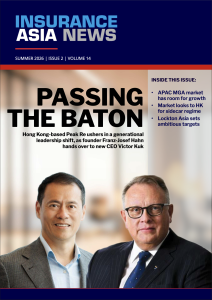
Blueprint. In an exclusive interview with IAN, Peak Re’s new chief executive Victor Kuk laid out his agenda for the Hong Kong reinsurer. Kuk wants to transform Peak Re into a “truly global” player, with expansion into new markets and solutions forming a central plank of its next phase of growth.
IAN also spoke exclusively to founding CEO Franz-Josef Hahn, who reflected on his decision to step down after 15 years, the challenges of building Peak Re, and his advice for his successor.
Heady valuations
The most exciting insurance startup in the world at the moment has to be Corgi. The Silicon Valley tech-spawned AI-first insurer doubled its valuation – from US$1.3 billion to US$2.6 billion – in literally three weeks.
The company that promises “insurance at the speed of compute” wasn’t built by, in the words of its founder Nico Laqua, “boomers and fax machines”.
Corgi is a “full stack insurer”, which is techspeak for a balance sheet business. It already holds licences as both a carrier and captive reinsurer, allowing it to retain risk.
Much has been written about its “intense” work culture that expect its employees to work seven days a week and earning a mattress after completing a month with the company.
However, I was intrigued by what is this new AI-native Silicon Valley insurer’s model that makes it so attractive and so valuable that it warrants a steep valuation markup in mere weeks.
Corgi is effectively a bet on the pace of improvement in large language models. Insurance runs on contracts, policy wordings and regulation—precisely the kind of structured text AI handles well.
As models improve, Corgi argues, insurers can be rebuilt as software: parsing documents, generating policies and orchestrating workflows at scale.
The “why now” is that these capabilities have crossed a threshold where they can operate in production. Unlike earlier Insurtech’s that layered better distribution on legacy carriers, Corgi is trying to rewrite the carrier itself as an AI-native system.
AI and undoing the “legacy” of carriers has been pitched in the past. Just ahead of the pandemic players like Lemonade and Hippo hit astronomical valuations driven by venture capital money.
The early valuations driven by a “hype cycle” did not withstand scrutiny. Lemonade was reportedly valued at around 100 times sales, in comparison Chubb trades at just over 2X sales.
Notably, Corgi is not training its own large language models. As co-founder Emily Yuan has said, the company plugs into existing LLMs.
That distinction matters. Strip away the AI wrapper and the proposition is straightforward: cut out the middlemen – the brokers, the MGAs and even the reinsurers.
None of this is entirely new. It has been tested in various iterations.
The past experiments haven’t delivered better profitability than traditional, broker‑driven carriers. Why? Because if you bypass brokers, you inherit their job: expensive customer acquisition in a low-engagement product and intensive claims support when things go wrong.
Early traction is strong for Corgi though.
Backer Kindred Ventures claims that company has in a few months scaled to serve over 40,000 policyholders across 49 states, “and is growing as rapidly as any company we have seen recently”.
Corgi’s model and the AI promise sounds enticing, but insurance is not software.
Growth in this business brings higher compliance burden, more claims complexity, more capital strain, and tighter scrutiny from carriers and regulators.
Distribution can scale faster than underwriting. You can add customers quickly, but you cannot easily add risk capacity, claims handling, or pricing discipline at the same speed.
It is whether it can grow profitably without turning into a capital-heavy insurer that faces the same constraints as the companies it set out to replace.
But for Laqua, it is about solving “big problems” and he sees insurance as a big problem that needs solving.
His analogy, however, does the heavy lifting. A few centuries ago, he says, ambition meant becoming a general, with success defined as “killing the enemies” – we can’t do today, “unfortunately”. Selling insurance, in that framing, becomes the next best outlet.
People moves
In senior appointments around the region, India’s largest insurer New India Assurance has picked Lavanya Mandayur as chairman and managing director.
Munich Re has bolstered its cyber leadership with the appointment of Marco Petrovic and Johanna Roman in regional roles.
In Hong Kong, QBE has hired Andy Tsui as head of underwriting, corporate, for Hong Kong and Macau.
Mapfre Re, meanwhile, has opened its India Gift City branch with Chaturbhuj Bansal in charge.
Do check out our weekly people move round-up to stay up to speed on the most important appointments in the region.
-
Full Capacity: EAIC reads the room on rates, risk and resilience
- September 19
This week's newsletter also discusses HK's new insurance initiatives, Miller's Malaysia entry, mounting costs from the Kumamoto earthquake, Ageas selling its Etiqa stake and the Zurich-Beazley deal.
-
Full Capacity: EAIC reads the room on rates, risk and resilience
- September 19
This week's newsletter also discusses HK's new insurance initiatives, Miller's Malaysia entry, mounting costs from the Kumamoto earthquake, Ageas selling its Etiqa stake and the Zurich-Beazley deal.
-
Envest, Labuan Re, Allianz Commercial, Willis: 14 APAC insurance people moves of the week
- September 18
Aon, Marsh, Howden, Lockton, Coface, BMS Group, Miller, Starr, Specialist Risk Group, and TQR also made personnel changes over the last week.
-
Gallagher Re, MDS Group, Howden, Bowring Marsh, Charles Taylor: 12 APAC insurance people moves of the week
- September 11
Swiss Re, Axa XL, Aviso Specialty, bolttech, Chubb, Markel, IFFCO Tokio General Insurance, Munich Re, Wills Re, Sompo, Coalition Australia, and Ace Insurance Brokers also made personnel changes over the last week.
-
BlackRock | Rethink the rules: how TAA and ETFs are reshaping portfolio construction
As global markets fragment into distinct regional poles, tactical asset allocation – powered by precise index data and ETF implementation – has become essential for navigating regime shifts and enhancing portfolio resilience. Daniel Caderas, Portfolio Manager, Global Tactical Asset Allocation APAC Lead, BlackRock Raman Aylur Subramanian, Managing Director, Index Research & Development, MSCI Part 1: […]
-
BlackRock | Infrastructure comes of age for insurers
Are insurers capturing full value from the asset class? BlackRock shares its perspective.
-
PartnerRe | The missing life stage: why caregiving is reshaping the future of protection in APAC
To stay relevant, insurers should engage caregivers earlier with solutions that combine protection, navigation support, and preventative planning.
-
BHSI | The real risk begins underwater: how subsea risk is changing insurance
Asia's subsea industry is expanding and evolving rapidly, with the growing use of technology across the region changing the way risks are be assessed.