

Full Capacity: Reckoning after Tai Po tragedy
December 6 2025 by Mithun Varkey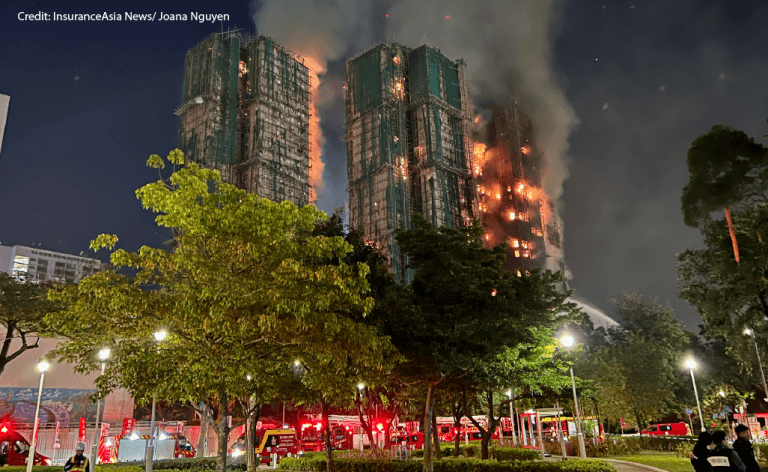
Welcome to Full Capacity, a weekly briefing on all the most important developments of the past week with a personal take on the news from our editor-in-chief, Mithun Varkey, delivered to your inbox every Saturday.
Brokering deals. Australian broker AUB Group’s sales talks with private equity firms EQT and CVC has been called off as the bidders walked away. The consortium informed the company that they do not wish to proceed with their bid at AU$45 (US$29.46) a share.
Meanwhile, AUB’s competitor Steadfast has seen stocks rally after reports that PE giant Blackstone was weighing a US$4.6 billion bid for the broker, which has been in the headlines recently for the wrong reasons.
M&A update. Tiptree shareholders have approved the sale of US specialty insurer Fortegra to South Korea’s DB Insurance. The all-cash deal, reported to be around US$1.65 billion, was approved at a special meeting on Wednesday.
DB Insurance signed an agreement to acquire Tiptree and Warburg Pincus-owned US specialty insurer Fortegra for US$1.65 billion in September.
Nat cat brief. Asia Pacific has accounted for around half of the US$22 billion total losses from tropical cyclones this year, according to Munich Re. The losses from windstorm events this year tracked far below the inflation-adjusted averages for the past 10 years (US$100 billion economic/US$40 billion insured), and the past 30 years (US$67 billion economic/US$26 billion insured).
Asia Pacific saw 27 tropical cyclones, 16 of which were of typhoon strength, develop in the Northwest Pacific by the end of November, while five became “super typhoons” in categories 3-5.
Elsewhere, Windstorm events have wreaked havoc across Southeast Asia and South Asia. Tropical Storm Senyar, which followed a rare track through the Strait of Malacca, has caused widespread flooding in Thailand and Indonesia, with combined economic losses estimated at about US$20 billion, according to Aon.
Tropical Storm Ditwah, the deadliest cyclone to hit Sri Lanka since 1978, is estimated to have caused US$613-835 million direct damage and about US$40 million in damages in India.
Meanwhile, the Philippines and Vietnam were impacted by Typhoon Koto over the past week, but the impact was relatively benign compared to other typhoons this year.
First reported. Allianz Re has announced a leadership change in APAC with Anna Kohls to take charge of the carrier as Kenrick Law has left the firm. Kohls will relocate from Munich to Singapore to lead the third-party P&C business across Asia Pacific. Law, who has been spearheading the reinsurer for nearly 12 years in the region, will take a break, he told InsuranceAsia News.
Wang Fuk Court fire forces market reset
The recent tragedy at Wang Fuk Court in Hong Kong’s Tai Po, where a devastating fire claimed 159 lives, is not just a heart-wrenching loss for the community but also a stark warning for the city’s insurance industry.
Beyond the devastating human loss, the tragedy has triggered deep questions about accountability, governance, and risk culture in one of the world’s most vertical cities.
It also threatens to upend long-standing assumptions in the insurance sector, where risk was priced too cheaply and managed too loosely for too long.
Market dynamics will harden swiftly.
Fitch anticipates insurers tightening project screening, mandating on-site monitoring, and hiking reserves for renovation risks – especially high-rises with scaffolding.
While immediate losses may be manageable, layered reinsurance arrangements and potential governmental support could mitigate longer-term impacts.
Yet, the reality is more complex. The Hong Kong Federation of Insurers estimates that gross insured losses could reach at least US$200 million, as InsuranceAsia News had first reported.
The loss is a substantial figure that suggests the fire may strain the financial underpinnings of the P&C sector.
This comes on the heels of an already tumultuous year marked by extreme weather events and other notable fire losses like the one in Chinachem Tower in October, which have eroded underwriting margins and highlighted the inherent risks of insuring properties in high-density urban areas.
The industry’s inevitable response will be a market hardening: higher premiums, stricter exclusions, and tighter underwriting for high-rise renovations.
Industry sources tell me that insurers and reinsurers are already revisiting pricing and conditions in the ongoing renewal discussions.
Initial investigations suggest that the fire’s rapid spread was accelerated by substandard plastic netting, tarpaulins, and foam boards used on building exteriors – materials failing basic fire safety standards.
The picture echoes the 2017 Grenfell Tower tragedy in London, where combustible cladding claimed 72 lives and subsequently reshaped the UK’s regulatory and insurance landscape.
Like Grenfell, the Wang Fuk Court disaster exposes how fragmented oversight and cost-driven decisions can create systemic vulnerabilities with catastrophic results.
It is already prompting calls for sweeping reform of Hong Kong’s fire-safety code, especially regarding building materials, scaffolding standards, and renovation approval processes.
For insurers, the claims complexities are immense. Multiple overlapping policies –property all-risk, contractors’ all-risk, third-party liability, and employee compensation – blur the lines of responsibility.
Legal wrangling could arise over “legal requirements clauses” that void coverage if safety standards were breached.
The Hong Kong Insurance Authority has acted quickly, forming a task force led by senior executives to coordinate the industry response and ensure speedy claims processing.
Insurers have set up hotlines, offered premium holidays and policy-loan relief, and pledged simplified claims procedures.
These gestures, though vital in the immediate aftermath, cannot substitute for structural reform. Insurance may cushion the economic blow, but only institutional reform can prevent the next inferno.
People moves
Liberty Specialty Markets has restructured its Asia Pacific underwriting operations. Key appointments include Marcus Thomas relocating to Hong Kong as CUO for commercial Asia and third-party APAC, and Brett Gardiner as CUO of Australia and first-party APAC.
QBE appointed Sebastian Tjornelund as head of marine underwriting for Asia.
Berkley Re Asia has promoted Si Wei Tay to head of claims, and Billy Kwan to head of property and business support.
Do check out our weekly people move round-up to stay up to speed on the most important appointments in the region.
-
Full Capacity: War risks spill over, M&A insurance’s scramble for talent
- March 21
This week's newsletter discusses an alarming prediction from the Swiss Re Institute, the latest from the crisis in the Middle East, Lloyd's new strategy, and the competition for talent in Asia's M&A insurance market.
-
Full Capacity: War risks spill over, M&A insurance’s scramble for talent
- March 21
This week's newsletter discusses an alarming prediction from the Swiss Re Institute, the latest from the crisis in the Middle East, Lloyd's new strategy, and the competition for talent in Asia's M&A insurance market.
-
Howden, Aviso Specialty, Price Forbes, QBE, Delta: 13 APAC insurance people moves of the week
- March 20
Sompo, Market Lane, QBE Re, HDI Global, Willis, BHSI, Swiss Re and BPL also made personnel changes over the last week.
-
Full Capacity: ILS: Will 2026 separate the pros from the posers?
- March 14
This week's newsletter discusses an IAN exclusive, US DFC's maritime reinsurance facility, Warburg Pincus' insurance platform sale, MSIG Asia's leadership change, woman in insurance and cat bonds outlook for 2026.
-
QBE | Elevating customer experience, humanising claims: QBE Asia’s ‘Solutions in a Box’
Vastly improving turnaround times and personalising service delivery, QBE Asia’s award-winning, end-to-end bundled claims solutions is a game-changer for the insurance industry.
-
Beazley | What does cyber protection look like from day 1 to day 600 and beyond?
Cybersecurity is no longer just an IT concern, but a governance issue that belongs on the boardroom agenda.
-
Sedgwick | Preparing for the next storm
Insurance industry needs to recalibrate, invest in innovation and strengthen systems, talent and data practices.
-
Peak Re | From climate modelling to market opportunity: Forging a new clarity on Southeast Asia’s climate risk
Southeast Asia's protection gap: a crisis of clarity, not just capital